Periodic table: 118 elements, symbols and atomic weights
Find elements from hydrogen to oganesson, then see what atomic number, symbols, categories and bracketed values mean.
|
Hydrogen
|
1 | 1 | H | Nonmetal | 1.008 |
|---|---|---|---|---|---|
|
Helium
|
2 | 2 | He | Noble gas | 4.0026 |
|
Lithium
|
3 | 3 | Li | Alkali metal | 6.94 |
|
Beryllium
|
4 | 4 | Be | Alkaline earth metal | 9.0122 |
|
Boron
|
5 | 5 | B | Metalloid | 10.81 |
|
Carbon
|
6 | 6 | C | Nonmetal | 12.011 |
|
Nitrogen
|
7 | 7 | N | Nonmetal | 14.007 |
|
Oxygen
|
8 | 8 | O | Nonmetal | 15.999 |
|
Fluorine
|
9 | 9 | F | Halogen | 18.998 |
|
Neon
|
10 | 10 | Ne | Noble gas | 20.18 |
|
Sodium
|
11 | 11 | Na | Alkali metal | 22.99 |
|
Magnesium
|
12 | 12 | Mg | Alkaline earth metal | 24.305 |
|
Aluminium
|
13 | 13 | Al | Post-transition metal | 26.982 |
|
Silicon
|
14 | 14 | Si | Metalloid | 28.085 |
|
Phosphorus
|
15 | 15 | P | Nonmetal | 30.974 |
|
Sulfur
|
16 | 16 | S | Nonmetal | 32.06 |
|
Chlorine
|
17 | 17 | Cl | Halogen | 35.45 |
|
Argon
|
18 | 18 | Ar | Noble gas | 39.948 |
|
Potassium
|
19 | 19 | K | Alkali metal | 39.098 |
|
Calcium
|
20 | 20 | Ca | Alkaline earth metal | 40.078 |
|
Scandium
|
21 | 21 | Sc | Transition metal | 44.956 |
|
Titanium
|
22 | 22 | Ti | Transition metal | 47.867 |
|
Vanadium
|
23 | 23 | V | Transition metal | 50.942 |
|
Chromium
|
24 | 24 | Cr | Transition metal | 51.996 |
|
Manganese
|
25 | 25 | Mn | Transition metal | 54.938 |
|
Iron
|
26 | 26 | Fe | Transition metal | 55.845 |
|
Cobalt
|
27 | 27 | Co | Transition metal | 58.933 |
|
Nickel
|
28 | 28 | Ni | Transition metal | 58.693 |
|
Copper
|
29 | 29 | Cu | Transition metal | 63.546 |
|
Zinc
|
30 | 30 | Zn | Transition metal | 65.38 |
|
Gallium
|
31 | 31 | Ga | Post-transition metal | 69.723 |
|
Germanium
|
32 | 32 | Ge | Metalloid | 72.63 |
|
Arsenic
|
33 | 33 | As | Metalloid | 74.922 |
|
Selenium
|
34 | 34 | Se | Nonmetal | 78.971 |
|
Bromine
|
35 | 35 | Br | Halogen | 79.904 |
|
Krypton
|
36 | 36 | Kr | Noble gas | 83.798 |
|
Rubidium
|
37 | 37 | Rb | Alkali metal | 85.468 |
|
Strontium
|
38 | 38 | Sr | Alkaline earth metal | 87.62 |
|
Yttrium
|
39 | 39 | Y | Transition metal | 88.906 |
|
Zirconium
|
40 | 40 | Zr | Transition metal | 91.224 |
|
Niobium
|
41 | 41 | Nb | Transition metal | 92.906 |
|
Molybdenum
|
42 | 42 | Mo | Transition metal | 95.95 |
|
Technetium
|
43 | 43 | Tc | Transition metal | 98 |
|
Ruthenium
|
44 | 44 | Ru | Transition metal | 101.07 |
|
Rhodium
|
45 | 45 | Rh | Transition metal | 102.91 |
|
Palladium
|
46 | 46 | Pd | Transition metal | 106.42 |
|
Silver
|
47 | 47 | Ag | Transition metal | 107.87 |
|
Cadmium
|
48 | 48 | Cd | Transition metal | 112.41 |
|
Indium
|
49 | 49 | In | Post-transition metal | 114.82 |
|
Tin
|
50 | 50 | Sn | Post-transition metal | 118.71 |
|
Antimony
|
51 | 51 | Sb | Metalloid | 121.76 |
|
Tellurium
|
52 | 52 | Te | Metalloid | 127.6 |
|
Iodine
|
53 | 53 | I | Halogen | 126.9 |
|
Xenon
|
54 | 54 | Xe | Noble gas | 131.29 |
|
Caesium
|
55 | 55 | Cs | Alkali metal | 132.91 |
|
Barium
|
56 | 56 | Ba | Alkaline earth metal | 137.33 |
|
Lanthanum
|
57 | 57 | La | Lanthanide | 138.91 |
|
Cerium
|
58 | 58 | Ce | Lanthanide | 140.12 |
|
Praseodymium
|
59 | 59 | Pr | Lanthanide | 140.91 |
|
Neodymium
|
60 | 60 | Nd | Lanthanide | 144.24 |
|
Promethium
|
61 | 61 | Pm | Lanthanide | 145 |
|
Samarium
|
62 | 62 | Sm | Lanthanide | 150.36 |
|
Europium
|
63 | 63 | Eu | Lanthanide | 151.96 |
|
Gadolinium
|
64 | 64 | Gd | Lanthanide | 157.25 |
|
Terbium
|
65 | 65 | Tb | Lanthanide | 158.93 |
|
Dysprosium
|
66 | 66 | Dy | Lanthanide | 162.5 |
|
Holmium
|
67 | 67 | Ho | Lanthanide | 164.93 |
|
Erbium
|
68 | 68 | Er | Lanthanide | 167.26 |
|
Thulium
|
69 | 69 | Tm | Lanthanide | 168.93 |
|
Ytterbium
|
70 | 70 | Yb | Lanthanide | 173.05 |
|
Lutetium
|
71 | 71 | Lu | Lanthanide | 174.97 |
|
Hafnium
|
72 | 72 | Hf | Transition metal | 178.49 |
|
Tantalum
|
73 | 73 | Ta | Transition metal | 180.95 |
|
Tungsten
|
74 | 74 | W | Transition metal | 183.84 |
|
Rhenium
|
75 | 75 | Re | Transition metal | 186.21 |
|
Osmium
|
76 | 76 | Os | Transition metal | 190.23 |
|
Iridium
|
77 | 77 | Ir | Transition metal | 192.22 |
|
Platinum
|
78 | 78 | Pt | Transition metal | 195.08 |
|
Gold
|
79 | 79 | Au | Transition metal | 196.97 |
|
Mercury
|
80 | 80 | Hg | Transition metal | 200.59 |
|
Thallium
|
81 | 81 | Tl | Post-transition metal | 204.38 |
|
Lead
|
82 | 82 | Pb | Post-transition metal | 207.2 |
|
Bismuth
|
83 | 83 | Bi | Post-transition metal | 208.98 |
|
Polonium
|
84 | 84 | Po | Metalloid | 209 |
|
Astatine
|
85 | 85 | At | Halogen | 210 |
|
Radon
|
86 | 86 | Rn | Noble gas | 222 |
|
Francium
|
87 | 87 | Fr | Alkali metal | 223 |
|
Radium
|
88 | 88 | Ra | Alkaline earth metal | 226 |
|
Actinium
|
89 | 89 | Ac | Actinide | 227 |
|
Thorium
|
90 | 90 | Th | Actinide | 232.04 |
|
Protactinium
|
91 | 91 | Pa | Actinide | 231.04 |
|
Uranium
|
92 | 92 | U | Actinide | 238.03 |
|
Neptunium
|
93 | 93 | Np | Actinide | 237 |
|
Plutonium
|
94 | 94 | Pu | Actinide | 244 |
|
Americium
|
95 | 95 | Am | Actinide | 243 |
|
Curium
|
96 | 96 | Cm | Actinide | 247 |
|
Berkelium
|
97 | 97 | Bk | Actinide | 247 |
|
Californium
|
98 | 98 | Cf | Actinide | 251 |
|
Einsteinium
|
99 | 99 | Es | Actinide | 252 |
|
Fermium
|
100 | 100 | Fm | Actinide | 257 |
|
Mendelevium
|
101 | 101 | Md | Actinide | 258 |
|
Nobelium
|
102 | 102 | No | Actinide | 259 |
|
Lawrencium
|
103 | 103 | Lr | Actinide | 266 |
|
Rutherfordium
|
104 | 104 | Rf | Transition metal | 267 |
|
Dubnium
|
105 | 105 | Db | Transition metal | 268 |
|
Seaborgium
|
106 | 106 | Sg | Transition metal | 269 |
|
Bohrium
|
107 | 107 | Bh | Transition metal | 270 |
|
Hassium
|
108 | 108 | Hs | Transition metal | 277 |
|
Meitnerium
|
109 | 109 | Mt | Transition metal | 278 |
|
Darmstadtium
|
110 | 110 | Ds | Transition metal | 281 |
|
Roentgenium
|
111 | 111 | Rg | Transition metal | 282 |
|
Copernicium
|
112 | 112 | Cn | Transition metal | 285 |
|
Nihonium
|
113 | 113 | Nh | Post-transition metal | 286 |
|
Flerovium
|
114 | 114 | Fl | Post-transition metal | 289 |
|
Moscovium
|
115 | 115 | Mc | Post-transition metal | 290 |
|
Livermorium
|
116 | 116 | Lv | Post-transition metal | 293 |
|
Tennessine
|
117 | 117 | Ts | Halogen | 294 |
|
Oganesson
|
118 | 118 | Og | Noble gas | 294 |
No item matched. Clear a filter or shorten the search.
About
Read the table from the detail you already have
This reference brings together the 118 recognised chemical elements, from hydrogen (Z = 1) to oganesson (Z = 118). Every row gives an atomic number, symbol, English name, category and reference atomic weight. Search Fe when a formula mentions iron, search 79 when an exercise gives an atomic number, or filter a family such as noble gases to compare a smaller group.
It is a practical starting point for studying, reading formulas, organising data and checking a name or symbol. It is not a safety sheet, laboratory specification or handling instruction. When a value affects an experiment, health decision, industrial process or disposal route, confirm the technical source that applies to that material and situation.
Atomic number is what makes an element itself
The atomic number, written as Z, is the number of protons in an atom’s nucleus. It defines the element: every atom with 6 protons is carbon, and every atom with 26 protons is iron. An atom can gain or lose electrons to form an ion without becoming a different element; changing the number of protons is what changes its identity.
The table is ordered by Z, not by atomic weight. That is why it can answer a direct question such as “what is element 47?” before any calculation: it is silver, Ag. Atomic weight remains useful, but it serves a different reading task from identifying the element.
A symbol is precise, including its capital letters
Chemical symbols follow an international convention, and case is part of the meaning. Co is cobalt, while CO is the formula for carbon monoxide. The first letter is capitalised and a second letter, if present, is lowercase: H, He, Na, Cl and Og.
Several symbols preserve historical names rather than the familiar English word. Na is sodium, K is potassium, Fe is iron, Ag is silver and Au is gold. Looking up the symbol instead of guessing from its letters is a small habit that prevents mistakes in equations, labels and inventories.
Atomic weight and mass number answer different questions
The atomic-weight column gives a reference value for an element. For elements found naturally as a mixture of isotopes, that value reflects the isotopic composition considered by the standard evaluation. This is why chlorine can be shown as 35.45 rather than a whole number.
That is not the same as the mass number of one nuclide. A mass number counts protons plus neutrons in a specific atom, such as carbon-12 or carbon-14. Atomic weight is meant to describe the element as a reference; a nuclide mass number identifies one isotope.
Why some entries use square brackets
Elements without stable isotopes, or without a characteristic terrestrial isotopic abundance, need a different label. In the IUPAC periodic table, a bracketed number is the mass number of the nuclide with the longest confirmed half-life. It should not be read as a standard atomic weight directly comparable with values for oxygen or silicon.
This distinction matters when calculations, documentation or source comparisons depend on the kind of value being used. The table is designed for quick consultation; IUPAC publications and subject-specific references take priority for standard atomic weights, isotopic composition or decay data.
What groups, periods and categories make easier to see
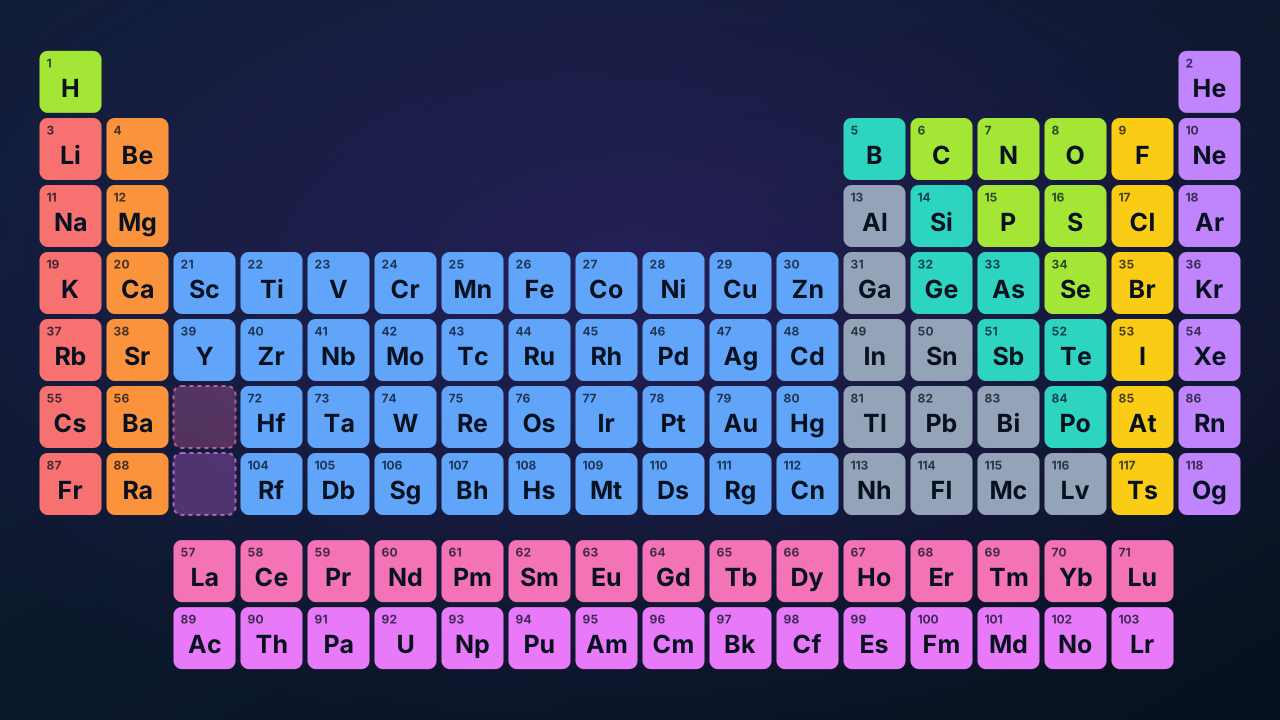
Horizontal rows are periods and vertical columns are groups. Elements in the same group often share broad valence-electron patterns, which helps explain some recurring chemical behaviour. The position is more informative than a single label, though: a useful interpretation combines the element, its group, period and the specific property being considered.
The categories in this list — alkali metals, alkaline earth metals, transition metals, lanthanides, actinides, metalloids, nonmetals, halogens and noble gases — make the 118 rows easier to explore. They are educational shortcuts, not a safety rating or a compatibility decision. Reactivity, radioactivity, oxidation state and risk still depend on the individual element and its form.
Lanthanides and actinides are usually drawn in two separate rows below the main table to keep the layout readable. They belong to periods 6 and 7 respectively; their separate position on the page does not put them outside the periodic table.
Use the list without memorising 118 rows
- Search by atomic number when you need the element identity.
- Search by symbol when reading a formula, label or technical table.
- Filter by category to make an initial comparison between families.
- Read atomic weights carefully, especially decimal values and bracketed entries.
The international reference for the names and presentation is the Periodic Table of Elements from IUPAC. This page organises those core identifiers for general reference; it does not replace material-specific technical documentation.
Frequently asked questions
How many elements are in the periodic table?
There are 118 recognised elements, from hydrogen with atomic number 1 to oganesson with atomic number 118. Scientific bodies confirm the identification and naming of any newly recognised elements.
What is the difference between atomic number and atomic weight?
Atomic number counts protons and defines the element. Atomic weight is a reference value related to the masses of its atoms and, for naturally occurring elements, can reflect an isotopic mixture. That is why an atomic weight is often not a whole number.
Why do Na and K not look like sodium and potassium?
The symbols come from historical names used in scientific nomenclature: Na from natrium and K from kalium. The same pattern gives Fe for iron and Ag for silver.