SI units: symbols, quantities and common uses
Metre, kilogram, second, ampere and dozens of derived SI units.
|
metre
|
1 | m | length | base | Distance and size |
|---|---|---|---|---|---|
|
kilogram
|
2 | kg | mass | base | Mass (not weight) |
|
second
|
3 | s | time | base | Time interval |
|
ampere
|
4 | A | electric current | base | Electric current |
|
kelvin
|
5 | K | thermodynamic temperature | base | Absolute temperature |
|
mole
|
6 | mol | amount of substance | base | Chemical counting |
|
candela
|
7 | cd | luminous intensity | base | Perceived brightness |
|
radian
|
8 | rad | plane angle | derived | Plane angle |
|
steradian
|
9 | sr | solid angle | derived | Solid angle |
|
hertz
|
10 | Hz | frequency | derived | Cycles per second |
|
newton
|
11 | N | force | derived | Force and weight |
|
pascal
|
12 | Pa | pressure | derived | Pressure and stress |
|
joule
|
13 | J | energy | derived | Energy and work |
|
watt
|
14 | W | power | derived | Energy rate |
|
coulomb
|
15 | C | electric charge | derived | Electric charge |
|
volt
|
16 | V | electric potential | derived | Electric voltage |
|
ohm
|
17 | Ω | electric resistance | derived | Resistance |
|
siemens
|
18 | S | electric conductance | derived | Conductance |
|
weber
|
19 | Wb | magnetic flux | derived | Magnetic flux |
|
tesla
|
20 | T | magnetic flux density | derived | Magnetic field |
|
henry
|
21 | H | inductance | derived | Inductance |
|
degree Celsius
|
22 | °C | Celsius temperature | derived | Everyday temperature |
|
lumen
|
23 | lm | luminous flux | derived | Light flux |
|
lux
|
24 | lx | illuminance | derived | Light per area |
|
becquerel
|
25 | Bq | activity | derived | Radioactivity |
|
gray
|
26 | Gy | absorbed dose | derived | Radiation dose |
|
sievert
|
27 | Sv | equivalent dose | derived | Biological dose |
|
katal
|
28 | kat | catalytic activity | derived | Catalysis |
|
litre
|
29 | L | volume | accepted | Liquid volume |
|
tonne
|
30 | t | mass | accepted | One thousand kilograms |
|
minute
|
31 | min | time | accepted | 60 seconds |
|
hour
|
32 | h | time | accepted | 3600 seconds |
|
day
|
33 | d | time | accepted | 86400 seconds |
|
hectare
|
34 | ha | area | accepted | 10,000 m² |
|
electronvolt
|
35 | eV | energy | accepted | Particle physics |
No item matched. Clear a filter or shorten the search.
About
A number only becomes a measurement when its unit stays with it
A battery marked simply as 60 tells you very little. 60 W, 60 Wh, 60 V, and 60 A describe different quantities: power, energy, electric potential difference, and electric current. Use this table to identify the quantity before turning a label, observation, or specification into a calculation.
The International System of Units, maintained by the BIPM, provides a shared language for measurement. It includes seven base units and many derived units. Familiar units such as the litre, minute, hour, and hectare are accepted for use with the SI, but they do not have the same role as the seven base units. That is why a useful reference can show metres and litres together without treating them as interchangeable categories.
The seven base units are the starting point, not a complete vocabulary
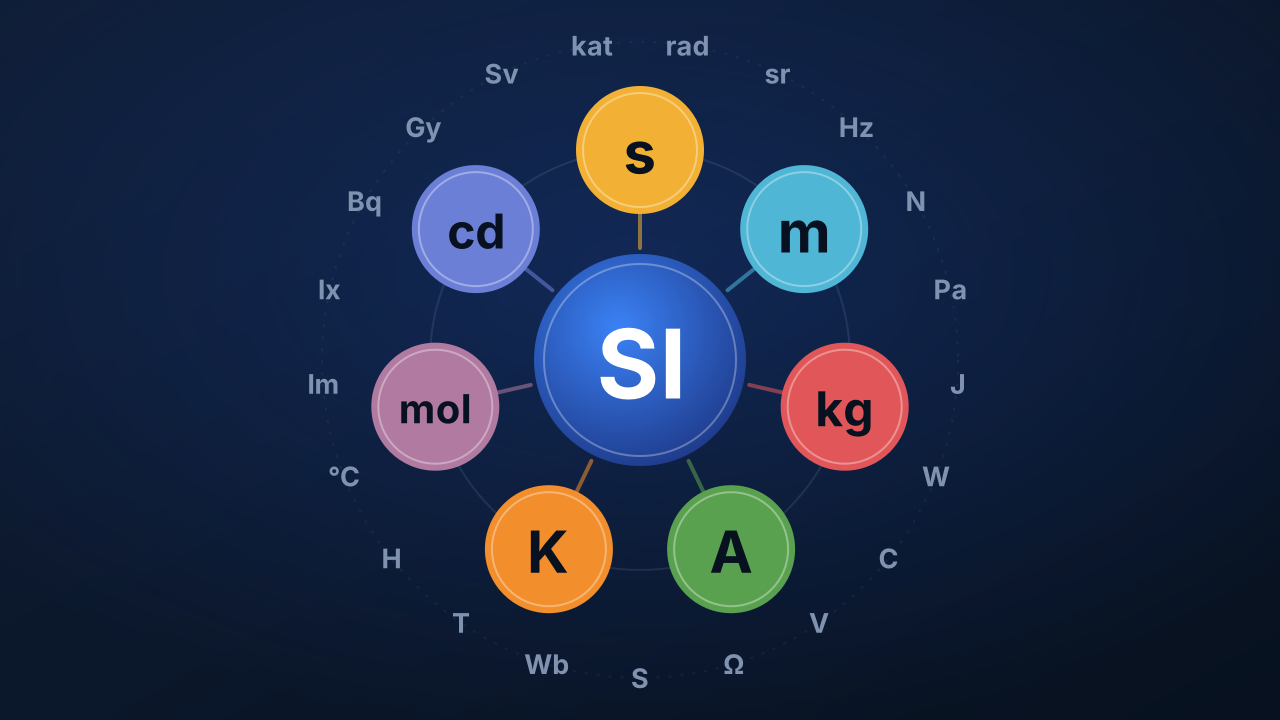
The metre (m) measures length; kilogram (kg), mass; second (s), time; ampere (A), electric current; kelvin (K), thermodynamic temperature; mole (mol), amount of substance; and candela (cd), luminous intensity. They support quantities that appear in ordinary work as well as in science: force, pressure, frequency, energy, and power.
Derived units are not secondary in practice. A newton (N) expresses force, a joule (J) energy, and a watt (W) power because their definitions combine base units. Filtering by type is useful when you know the quantity you need but do not want to reconstruct a formula before finding the appropriate unit.
Symbols are written differently from ordinary abbreviations
Unit symbols do not take a full stop or a plural ending. Write 12 m, 5 kg, and 30 s, leaving a space between the numerical value and the symbol. The same convention applies to derived units: 100 W, 220 V, and 3 Pa.
Capitalisation matters. W is watt and Pa is pascal, both named after people; m is metre and s is second. A different letter case can change a symbol or make a copied value unclear in a spreadsheet, label, or technical document.
Prefixes change scale, not the quantity itself
Kilo, milli, micro, and mega express decimal multiples or submultiples. A kilometre is still a length, and a millivolt is still a potential difference. Check the unit after the prefix before converting: kW and kWh are not interchangeable because power and energy are different quantities.
Mass has one practical exception worth remembering. The SI base unit is the kilogram, but prefixes are attached to the gram. That is why milligram (mg) and megagram (Mg) are used. When a conversion affects a dosage, a design, or safety, show the factor used instead of relying on memory.
Common pairs that should not be swapped
Everyday speech often uses weight to mean mass. In physics, mass is measured in kilograms, while weight is a force measured in newtons. The distinction matters whenever gravity, acceleration, or load calculations are involved.
Energy and power are another common mix-up. A watt measures the rate at which energy is transferred: one joule per second. A 10 W lamp states its power. To estimate energy used, you also need the length of time it ran.
Kelvin and degrees Celsius are written differently as well. Kelvin uses K, without a degree sign; Celsius uses °C. A change of 1 °C equals a change of 1 K, but the scales have different zero points. For absolute temperature, T in kelvin equals t in degrees Celsius plus 273.15.
How to use this reference
Search by quantity when you know what is being measured, or by symbol when a label, circuit, or formula gives you only the notation. The type filter separates base, derived, and accepted units. The rows are a practical reference, not a universal converter: keep units compatible and write the full operation when converting between systems or combining quantities.
The SI Brochure is the international reference for formal definitions. Consult it and any sector-specific standard when a conversion is regulated, safety-critical, or part of a formal report.
Frequently asked questions
What is the difference between kg and N?
kg measures mass. N measures force. Weight is a force, even though everyday language often gives a person’s mass in kilograms and calls it weight.
Do W and Wh mean the same thing?
No. W measures power, while Wh measures energy accumulated or consumed over time. Time is required to relate the two.
Why does kelvin have no degree sign?
Kelvin is the SI unit of thermodynamic temperature and its symbol is K. The degree sign belongs to degrees Celsius, written °C.